HISTORY ON POSTAL STAMPS OF ROMANIA
THE “PATRIOTIC DEFENSE” SET OF 1945
The set "Patriotic Defense" was issued by the Romanian postal administration on August 25, 1945. It commemorated the first anniversary of the creation of the communist militias "Patriotic Defense".
Prior events
World War II begins on September 1, after the attack by Nazi Germany of Poland, and then on September 15 the attack of the same country by the USSR (according to the secret annex to the Molotov-Ribbentrop Pact, signed on August 23, 1939). After a period of neutrality of more than a year, Romania changes its alliances with the coming to power of Ion Antonescu. He allied with the Axis Powers in October 1940 and entered the war on their side in June 1941, with the stated aim of recovering the territories taken by the USSR following an 1940 ultimatum: Bessarabia, Northern Bukovina and Hertza County.
After over three years of military campaigns against the USSR, which led the Romanian army to the steppes of the North Caucasus and the defeat at Stalingrad (where Romania had nothing to recover), on August 23, 1944, with the Soviet army that was already in Northern Moldova since March, King Michael agrees to the forcible removal of Marshal Antonescu if the later refuses to sign an armistice with the United Nations.
Following Antonescu's clear refusal, King Mihai deposed and let arrested him, and Romania sided with the Allies. Romania's participation in World War II was therefore characterized by two campaigns: the eastern one, for the liberation of Bessarabia and Bukovina (plus the conquest of other, non-romanian territories), war lost, and the western one, which brought after the Paris Treaty the reintegration of Transylvania to Romania. Source.
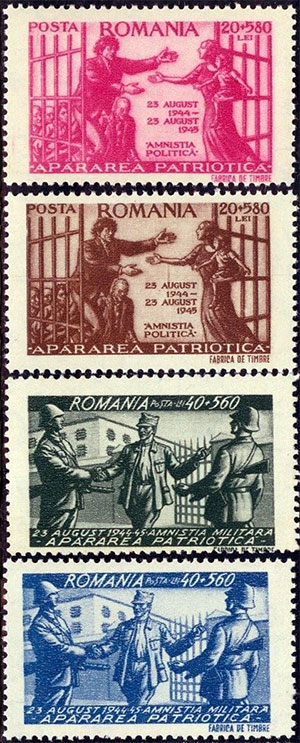
Characteristics of the Patriotic Defense series, Michel 885 – 896, Scott B292-B303
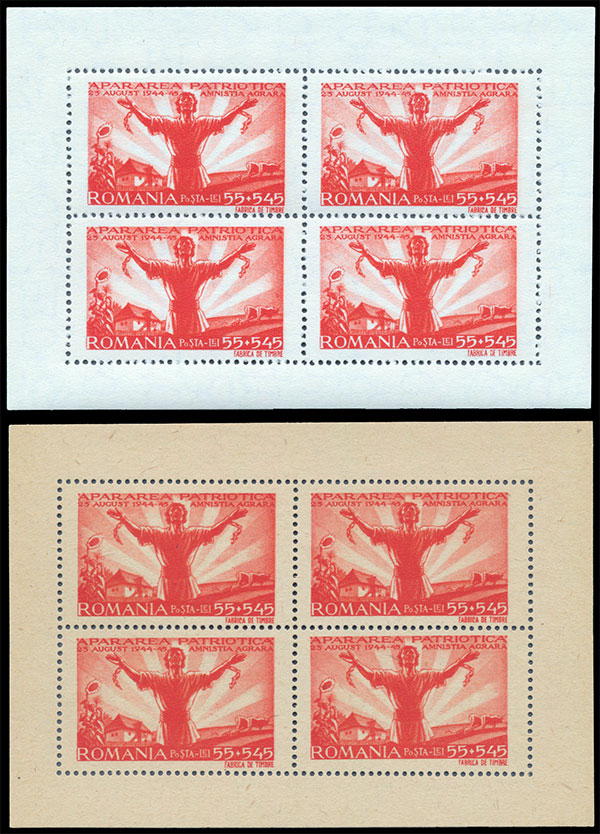
The set was issued in blocks of four and, as an unusual feature, on both white and gray ( no gum) paper. I do not know the reason for this strangeness, but I can imagine that due to the post-war shortages there were problems with the supply of paper. In addition, the existence of the two varieties increased sales, stamp collectors being known to want to take possession of everything that was issued.
The desire to exploit philatelists is also seen in the facial values of the stamps of this charity series. Thus, the first stamp has a value of 20 lei + 580 lei, so with an enormous surcharge of almost 3,000%. The exploitation is also seen from the fact that for the same subject there are two identical stamps, but in different colors. Issuance in four-stamp units, not in large sheets, is another sign of the desire to exploit people fresh out of a devastating war.
A few words about the organization "Patriotic Defense"
The idea of the Patriotic Guard formations is of Soviet origin. The first groups of armed communist workers date from the summer of 1944. Developing the nucleus of those who took over Marshal Ion Antonescu after his arrest on August 23, 1944, P.C.d.R. (the then name of the small communist party in Romania), the communist party decided to establish, in September 1944, the Patriotic Defense Guards. The preparation and organization of their formations was done under the supervision of the Soviet NKGB security services. Among the members of the Guards were also common law detainees or former legionaries "converted" to work with the Communists. Whenever necessary, the Patriotic Defense Guards received logistical support from the Soviet Command.
The Patriotic Defense Guards were also used by the Communists as groups of thugs whose role was to spread the demonstrations organized by the Democratic parties and to terrorize their members. The great demonstration organized in Bucharest, on November 8, 1945, by the supporters of democracy, monarchy and King Mihai, was scattered by the communists with the help of trucks full with workers, among whom were members of the Patriotic Defense Guards, armed with sticks. and other blunt objects.
On January 15, 1945, the then (non-communist) prime minister, General Radescu, ordered the dissolution of the Patriotic Defense Guards, but communist leaders ignored his order. The communist formations were disbanded only after the completion of the process of Sovietization of Romania. Source.
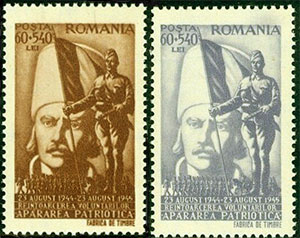
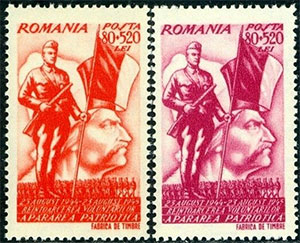
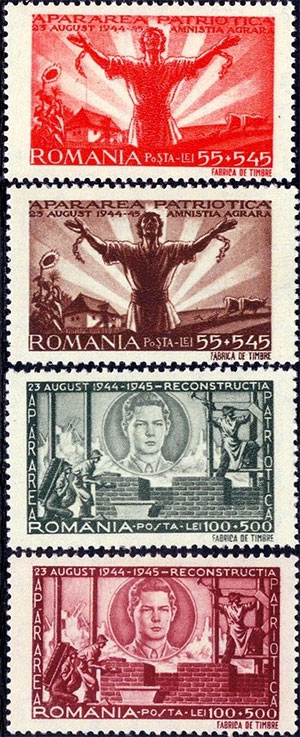
"Patriotic Defense" set, description and comments
It is difficult to know precisely, after so many years, what is the significance of what was written on these pro-communist propaganda stamps, but it is not too difficult to infer.
- Political amnesty. We see a man coming out of a prison camp-like space, somehow above the crowd (carried on someone's back, possibly being injured?), reaching out his hands to a woman with a small child in her arms. The couple seems to be waiting for their husband and father. We do not know for what deeds the man was amnestied.
- Military amnesty. It could be about the military men who fought the Soviet army and later refused to return the weapons again Nazis.
- Agrarian amnesty. It is not clear to me for what deeds the "peasant" released from chains in the image was amnestied.
- Reconstruction. It is about the promise of rebuilding the country after the war, under the auspices of the young King Michael (who will be dethroned and expelled after less than 3 years by the communists who came to power).
- Volunteers return. Against the background of Tudor Vladimirescu, elevated to the rank of hero, we are shown a soldier who fought as a volunteer against Nazi Germany. Another one is shown against the background of the hero of a past uprising, Horia.
Below I show a four-stamp package (Agrarian Amnesty) in the two paper versions, white and gray.
This set is rather expensive, being rare as a complete set of blocks. In the 2009 Scott catalogue, a complete MNH set on white and gray paper is priced at $ 240. In the Michel 2017 catalogue a complete MNH set on white and gray paper is valued at Euro 300, and a full set of minisheets at Euro 850. The print run was of 22,000 sets what means 4,400 sheets. Probably less than 500 full sheets survived in their original form and this explains their rarity.
A set that is remarkable in both its value and its historical significance.